
Common Optimizations for Levenshtein Edit Distance
Robert Jacobson | 2 Dec 2024
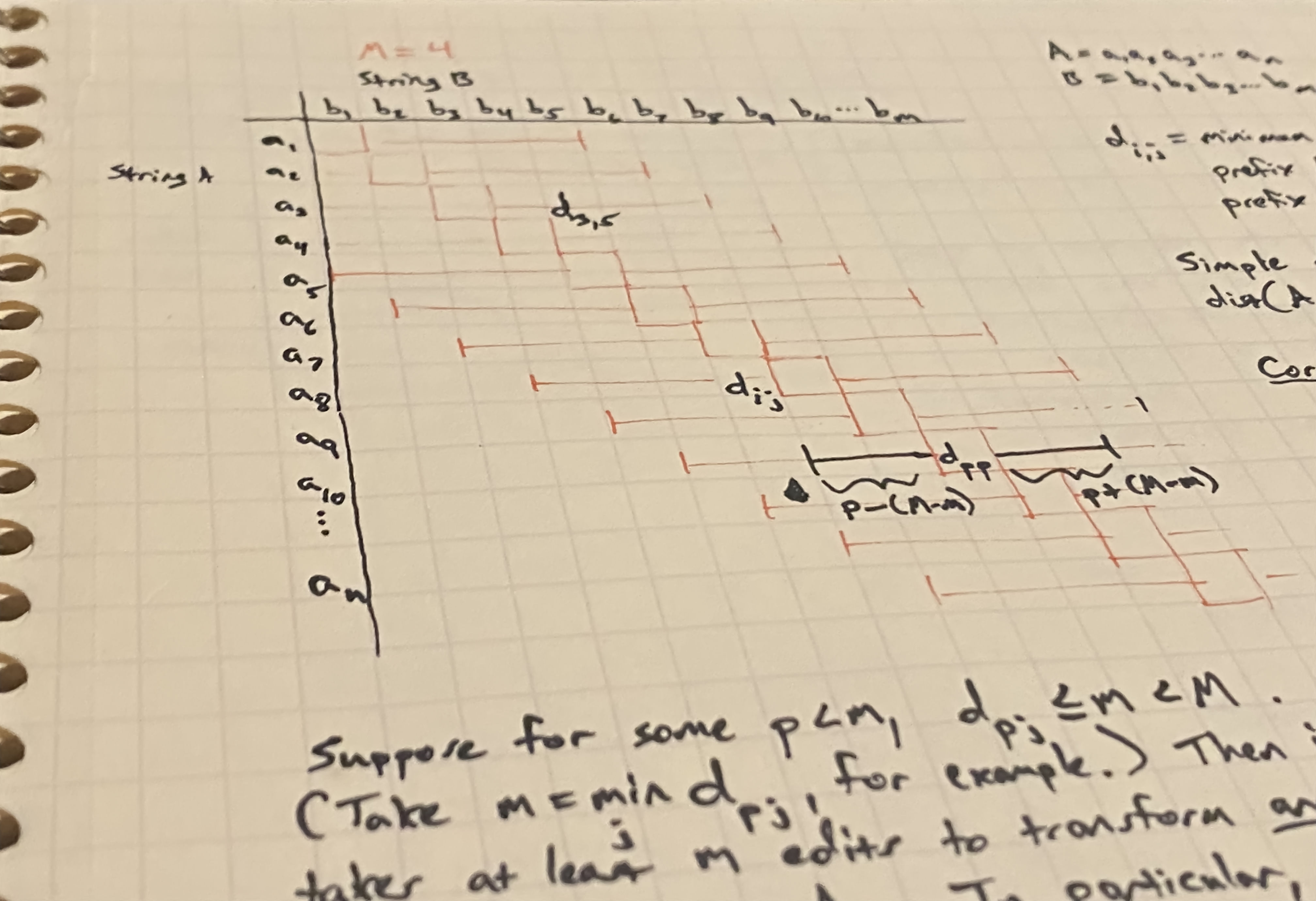
I have been studying algorithms to compute the Levenshtein edit distance between two strings, which is defined as the minimum number of “edits” required to transform one string into another string. This is useful for a variety of things, from DNA sequence alignment to spell correction to address validation. I am studying it to resolve misspelled and OCR’ed scientific names of organisms to their real names, a famous problem in the field. The idea, of course, is to search a list of correct names for the given name and select the correct name that has the lowest distance to the given name. Sometimes this is called fuzzy matching.
Making a Pratt Parser Generator Part 1
Robert Jacobson | 13 Aug 2020

A brief history of the Pratt parsing algorithm
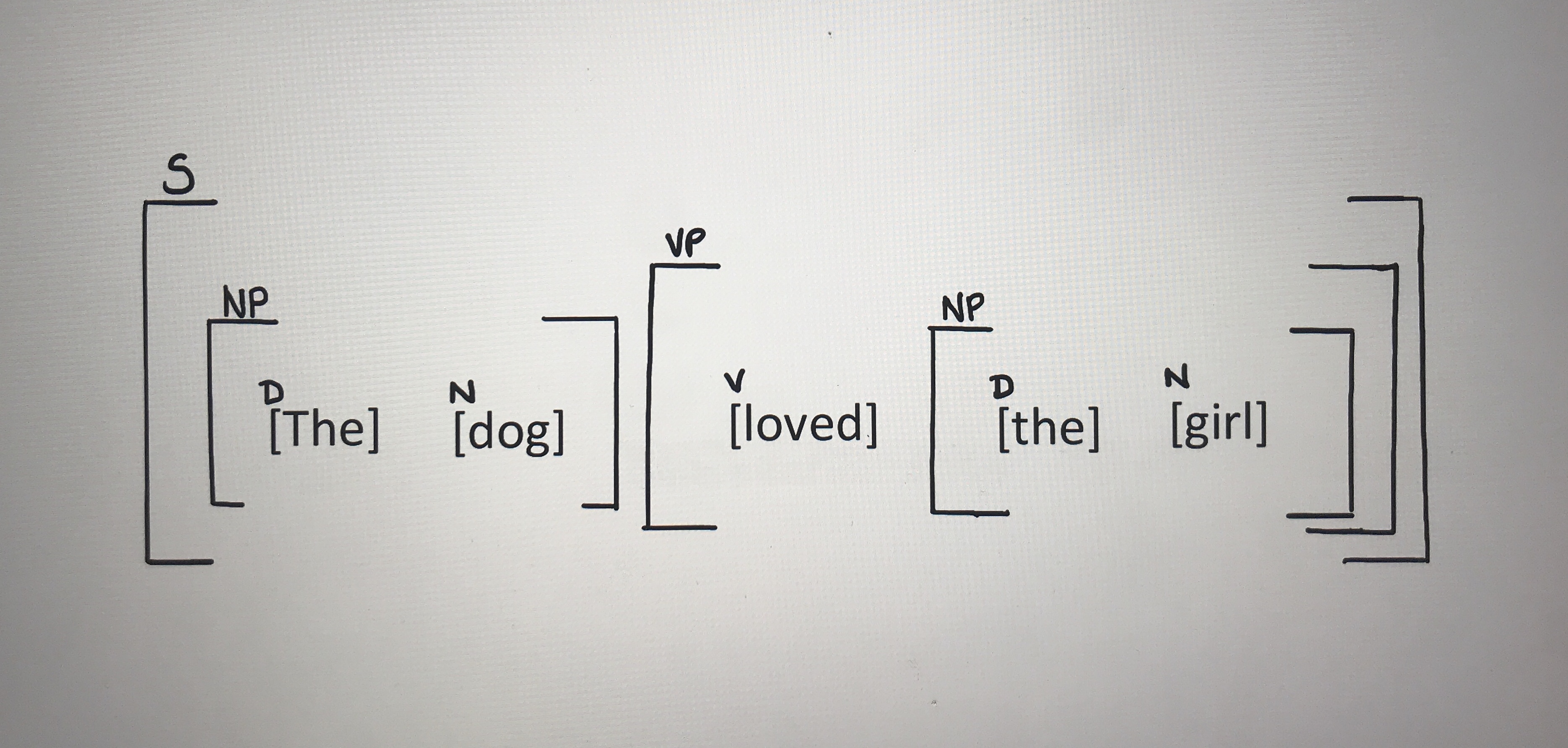
The history of programming language parsers is dominated by the thorny challenge of parsing expressions, mathematical expressions in particular, taking into account the precedence of operators in the expressions. Modern formal language theory began with the work of Noam Chomsky in the 1950s, in which Chomsky lays out a mathematical framework for linguistics. Under this mathematical framework, languages exist within a hierarchy of languages defined according to how difficult the language is to parse.1 But computer programmers needed practical, efficient algorithms to parse computer programs for translation to machine code. Parsers of the 1950s relied on ad hoc logic rather than systematic algorithms (a feature which persists to this day, though to a much lesser degree). The 1960s was a golden age of parsing algorithm research when nearly all of the concepts and algorithms we use today were discovered and rigorously studied. By the early 1970s, parsing theory had evolved to the point that Stephen C. Johnson, a computer scientist at Bell Labs / AT&T, was able to start work on YACC (now “Yacc”), “Yet Another Compiler Compiler.”2 YACC was first publically described in 1975 and shipped with Unix version 33 and is still in use today.
Bayes' Theorem and the Deathly Hallows
Robert Jacobson | 1 Jul 2020

This article is an expanded version of the math part of an article I cowrote with marine biologist Dr. Andrew Rhyne about how many well-meaning public health professionals have misinterpreted the math behind test efficiency, Bayes’ Theorem. This misinterpretation has lead to dangerous public policy positions. Anyone with a math allergy is invited to read that article instead.
I and Dr. Andrew Rhyne, marine biologist and my longtime collaborator in fighting wildlife crime, have spent a lot of time in the last several months working on how best to fight the COVID-19 pandemic, especially in college communities like our own Roger Williams University.
What is the IELR(1) Parsing Algorithm?
Robert Jacobson | 10 Oct 2018
This short article is for those students, programmers, and computer scientists who already have a basic idea of what a parser is and does but who want to know what that mysterious reference to “IELR(1)” means in the Bison parser generator manual.
The IELR(1) Parsing Algorithm
The IELR(1) parsing algorithm was developed in 2008 by Joel E. Denny as part of his Ph.D. research under the supervision of Brian A. Malloy at Clemson University. The IELR(1) algorithm is a variation of the so-called “minimal” LR(1) algorithm developed by David Pager in 1977, which itself is a variation of the LR(k) parsing algorithm invented by Donald Knuth in 1965. The IE in IELR(1) stands for inadequacy elimination (see last section).
Defining the Wolfram Language Part 2: Operator Properties
Robert Jacobson | 4 Sep 2018
In this third installment of our n part series, “Defining the Wolfram Language,” we begin to study the properties, namely the arity, affix, associativity, and precedence, of the Mathematica operators we found in Part 1. If we ended Part 1 proud of our accomplishment—perhaps even a little smug—then we will get reacquainted with our humility in this article.

Generalizing PEMDAS: What is an operator?
Robert Jacobson | 3 Sep 2018

In programming languages, an operator is a symbol used to represent a specific operation such as subtraction of integers or dereferencing a pointer. The symbols +, *, and ! are commonly used as operators in many programming languages, for example. In this article we define some basic programming language terminology that allows us to categorize operators according to their different properties.
Computation with Expressions
Virtually all programming languages have expressions, like 2 + 4, which consist of operators (the + operator in 2 + 4) and their operands (or arguments; the 2 and the 4), that is, the things operators operate on. This language is barrowed from mathematics where, for example, $17/2 + \sin(\pi/2)$ is an expression that evaluates to the value $19/2$. Most programming languages also have other language constructs like statements and declarations that are not expressions. In some languages, like Wolfram Language, everything is an expression. In these languages, an entire program itself is an expression, albeit possibly a very complex one, and executing a program is called evaluation.
Defining the Wolfram Language Part 1: Finding Operators
Robert Jacobson | 16 Aug 2018
Finding All Wolfram Language Operators
In this second article, Part 1 of an n part series on Defining the Wolfram Language, we start getting our hands dirty hunting down every single operator in Mathematica and each operator’s linguistic properties. To my knowledge, nobody outside of Wolfram has created such an exhaustive list before.
Defining the Wolfram Language Part 0: The Challenge
Robert Jacobson | 2 Jul 2018
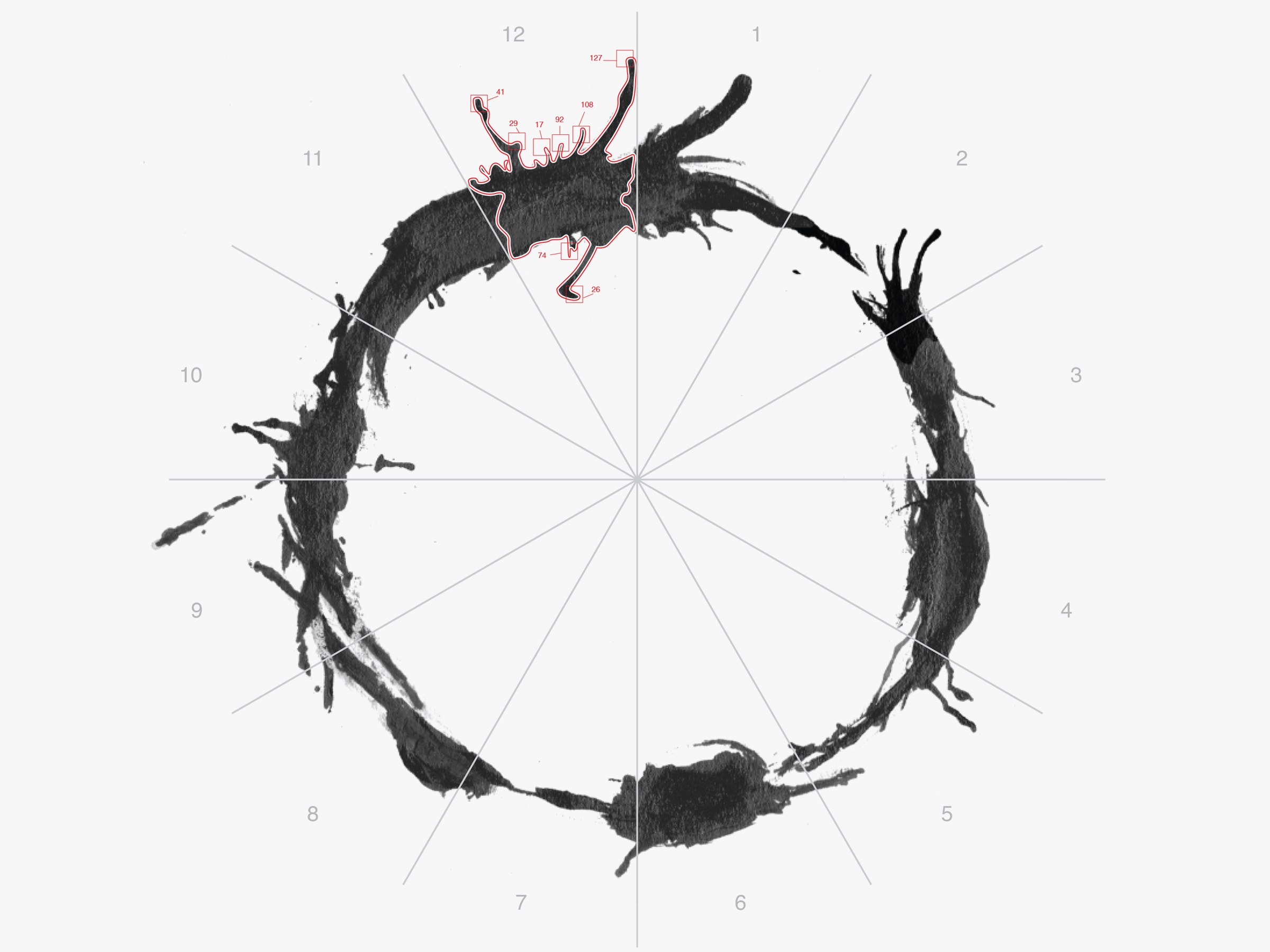
What is the definition of the Wolfram Language? This is the first in a series of articles attempting to answer this question.

The grammar of mathematical expressions
Robert Jacobson | 28 Jan 2015
Using computers to do automatic translation has a long and rich history in computer science. A course in compiler construction is a veritable survey of topics in computer science running the gamut from formal languages to data structures and algorithms to Hopfcroft’s algorithm to minimize deterministic automata. One of the first things a student learns in a compiler construction course is how to formally describe the grammar of a language using (extended) Backus–Naur form (EBNF).

Using Mathematica From Python
Robert Jacobson | 10 Dec 2014
In which I show you how to programmatically interface with a Mathematica kernel from Python.